Case study · Shopify · United States2021 to 2026 · Ongoing
Ecommerce SEO for $250K to $10M Shopify brands
From zero rankings to $3.4M a year in organic revenue, on $3.5K a month.
How one Shopify store went from invisible in search to outranking Amazon for its most competitive terms. Every step, every number, and the one mistake that stops most stores before results kick in.
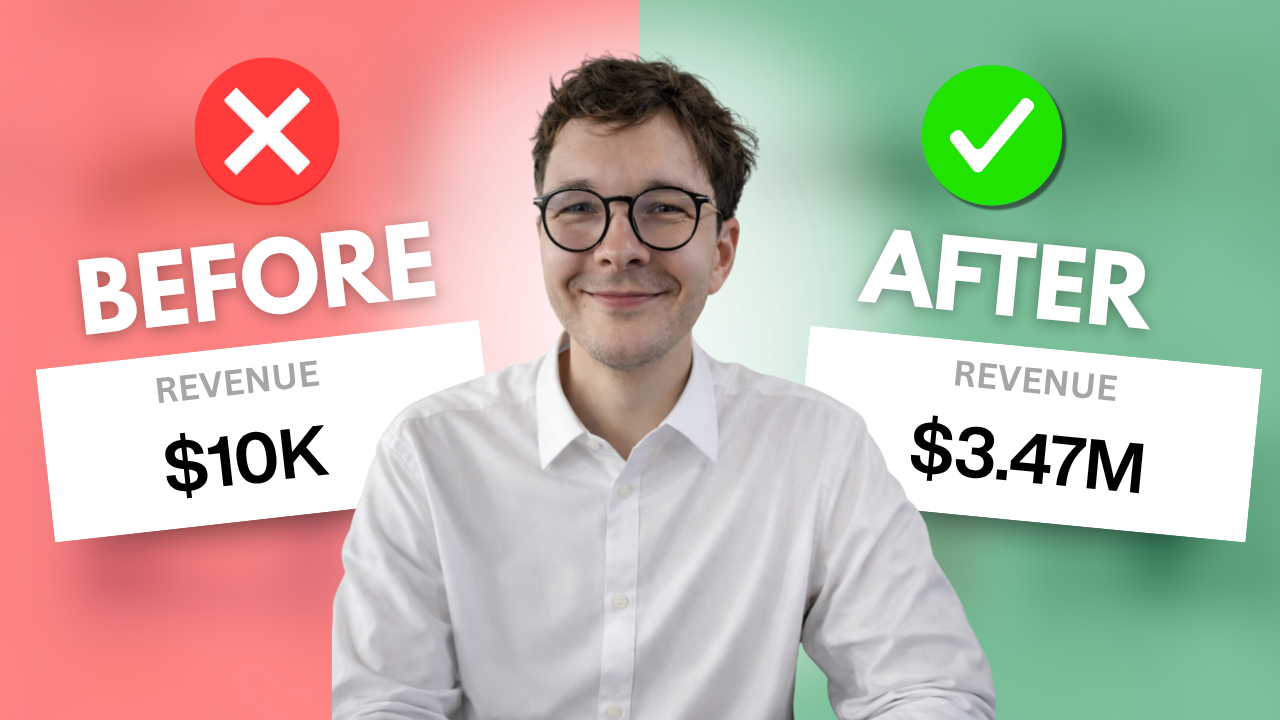
This store pays us $3,500 a month. In the last 12 months, organic search brought them over $3.4 million in revenue, 13% of their $26M annual total according to Google Analytics. When we started in August 2021 they were not ranking for anything. Today they beat Amazon for their most competitive search terms.
I'm going to show you exactly how, in the order we did it. Not a highlight reel: the full strategy, what they invested, what it returned, and what we'd tell any store owner thinking about SEO.
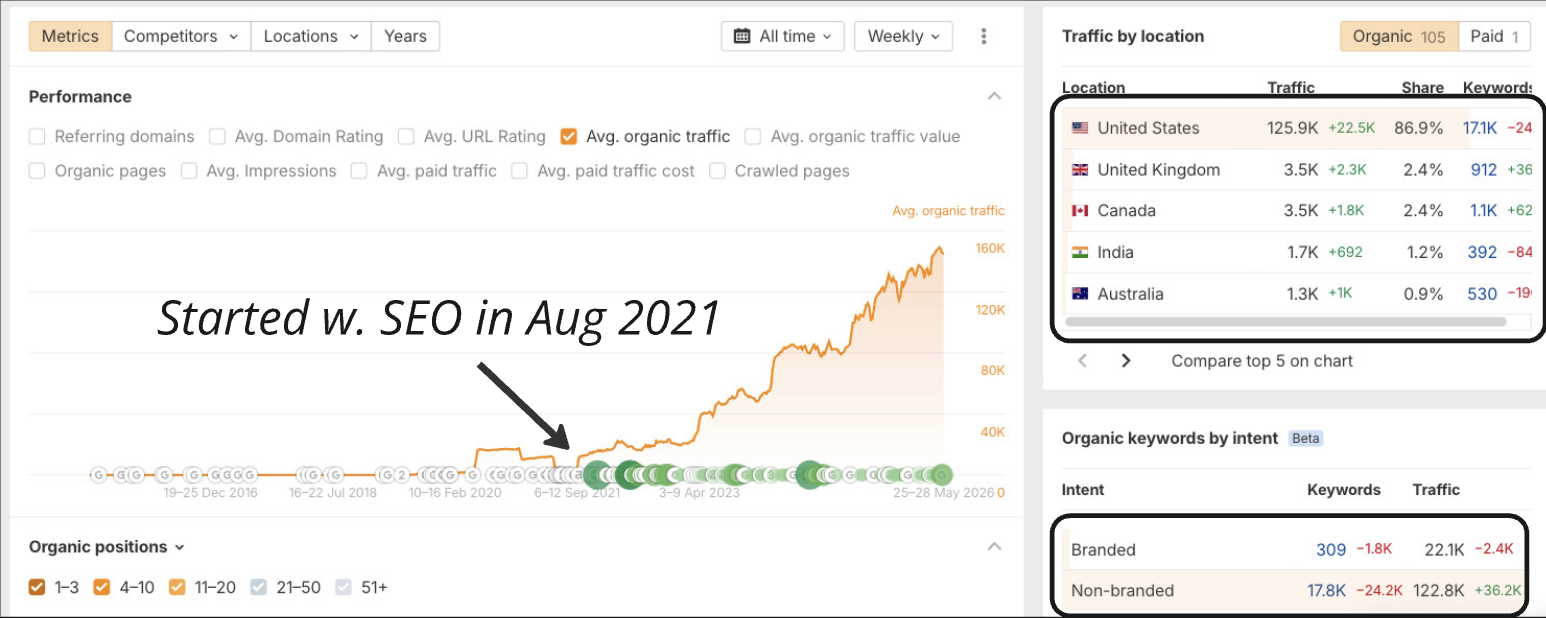
Fig. 01 · Organic traffic, all time. SEO started August 2021. 86.9% of traffic from the United States, and 122.8K of 145K monthly visits are non-branded.
Two years ago I recorded a video on this same client at around 83,000 organic visitors a month. Now it's over 150,000. The detail that matters most is at the bottom right of that screenshot: the split between branded and non-branded traffic. If someone types the brand name into Google, they already knew the business. That isn't SEO's doing and we don't take credit for it. 85% of this traffic is people who had never heard of them. That's the number you want for your own store.
01
Step one, always
Is SEO even worth doing in this niche?
Before we touch a single page, we answer one question: given this niche and these product prices, is organic search a worthwhile channel at all? We don't want to work with a store for four months and be embarrassed at the end because there was never a result to be had. There are plenty of stores where SEO is a genuine growth engine. We'd rather focus on those and tell the others to invest elsewhere.
Here's how we run that analysis, using protein powder as a neutral example (it isn't tied to this client).
1. Is there demand?
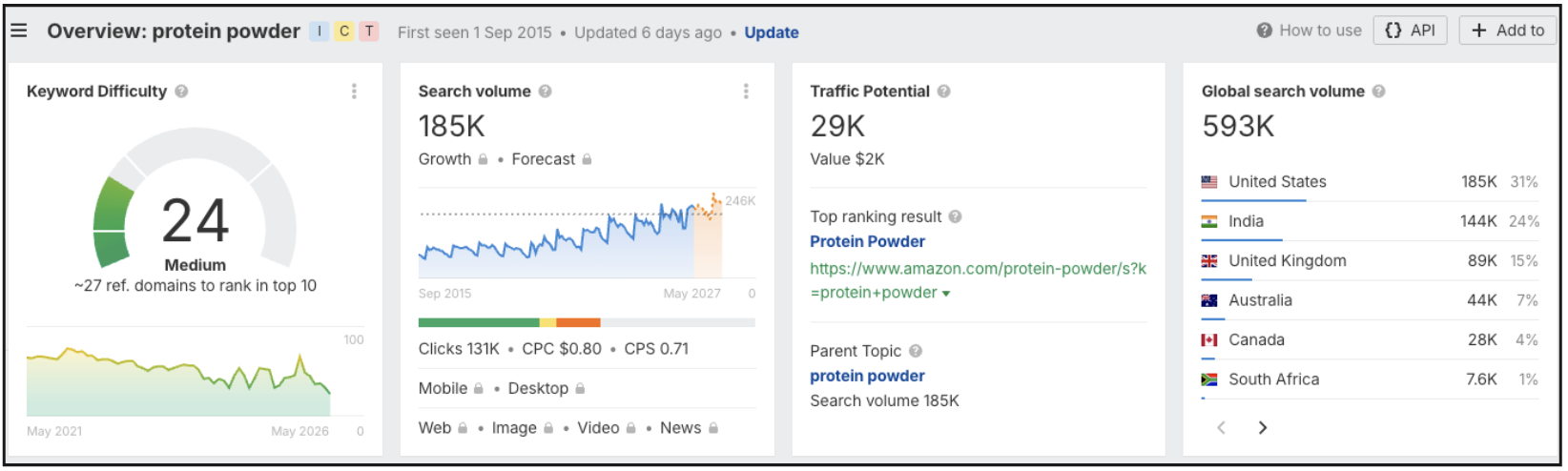
We look at what people actually type into Google or AI to find products like yours, and how many do it per month from the countries you ship to. For "protein powder", global demand is close to 600K searches a month, 185K of them in the US, and the trend is up.
Fig. 02 · Keyword demand check. 185K US searches a month, 593K globally, difficulty 24 out of 100.
2. What are the top rankers getting?
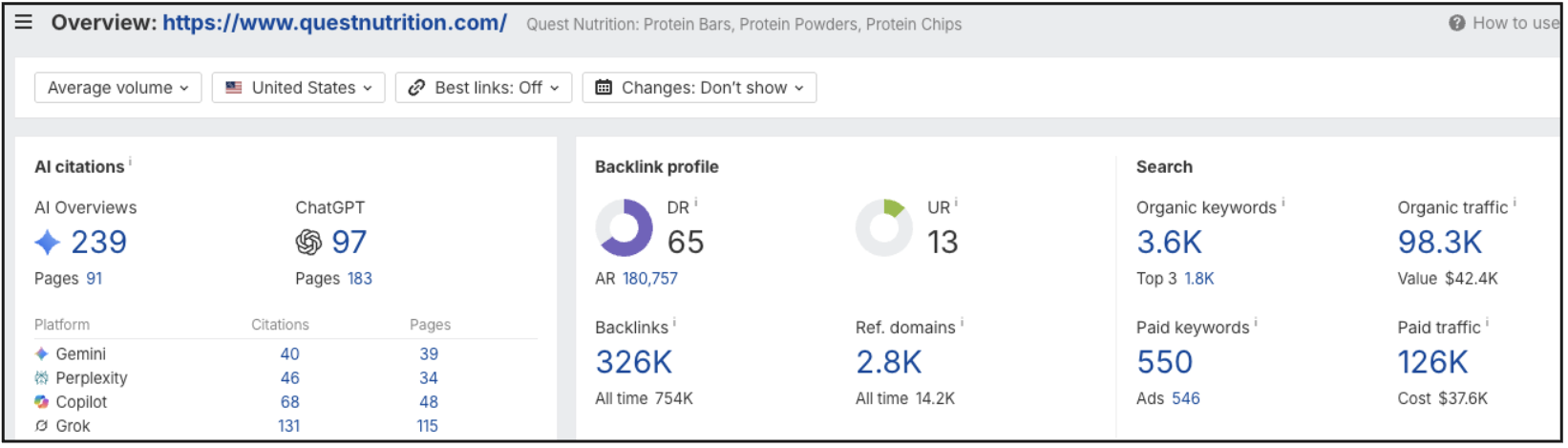
Then we look at who currently ranks for those terms and how much traffic their domains pull. Quest Nutrition gets close to 100K organic visitors a month. Premier Protein close to 200K. That tells us the ceiling: what's realistically available if you get to the top.
Fig. 03 · Competitor ceiling. Quest Nutrition: 98.3K monthly organic visits, DR 65, 239 AI Overview citations.
3. Run the numbers, conservatively
Take a 200K monthly traffic potential, a $50 average order value, and a 2.5% conversion rate (deliberately low for this niche). Ignore repeat purchases entirely, even though most stores see them. That gives an annual organic revenue potential of about $2.73M. The real number for protein powder is far higher, but we want the floor, not the ceiling.
Traffic / mo
200K
Conv. rate
2.5%
AOV
$50
Revenue / yr
$2.73M
4. What does it do to company value?
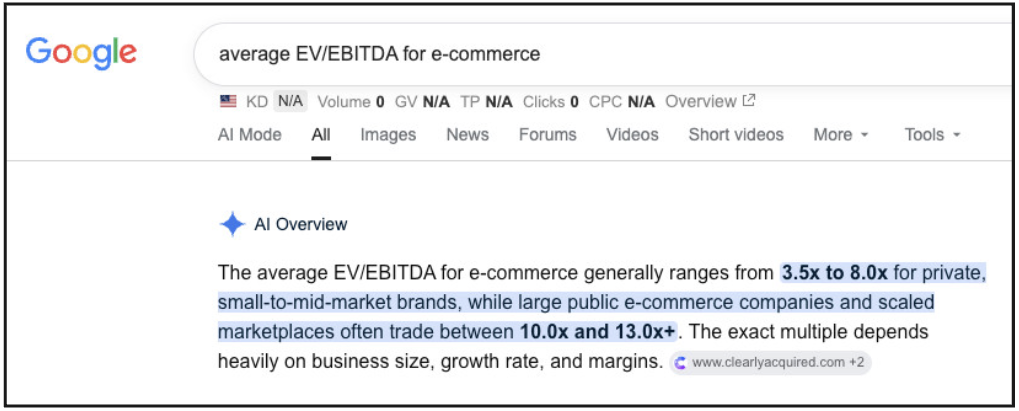
If you're in ecommerce for the long haul, you should be thinking about what your store is worth, not just what it sells. Private small to mid-market ecommerce brands typically trade at 3.5x to 8x EBITDA. We use 5x as a middle-of-the-road figure.
Fig. 04 · Ecommerce valuation multiples. 3.5x to 8x EBITDA for private brands; we model at 5x.
At a 50% gross margin, $2.73M in organic revenue is roughly $1.36M in extra annual profit. At 5x, that's about $6.8M added to what a buyer would pay for the store. Sophisticated buyers also know that SEO traffic is more consistent than influencer or paid channels, which makes a store with a working organic channel far easier to sell.
This is the free audit
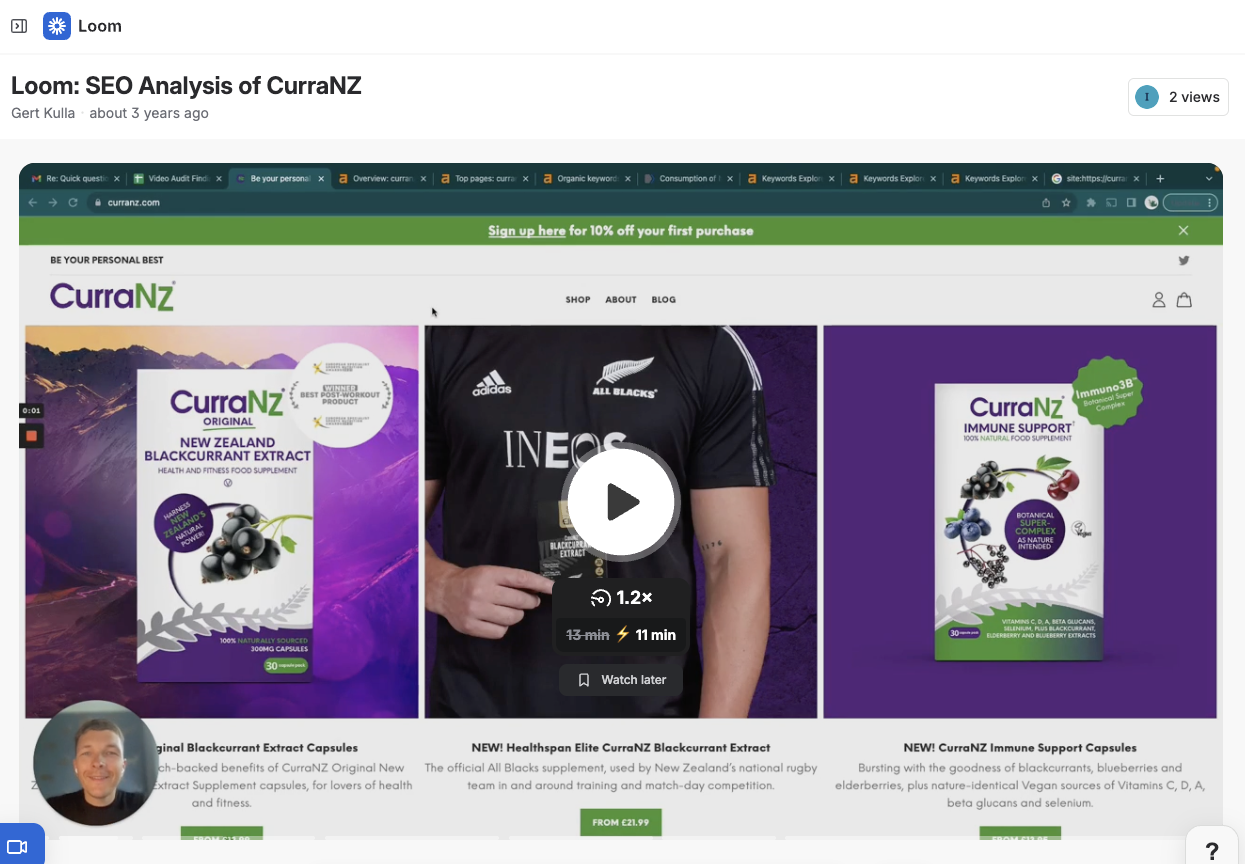
We run exactly this niche potential analysis for a limited number of Shopify, WooCommerce and BigCommerce stores doing $250K to $10M a year, free, as a 5 to 7 minute personalised video. 20 per month, first come first served, and we'll say no if we don't think you're a fit.
Find the one gap that matters, then allocate everything to it.
Once we know SEO is worth doing, we spend 5 to 10 hours on a strategy audit: who is at the top right now, why are they there, and why isn't this store? The gaps between those answers become a resource allocation plan.
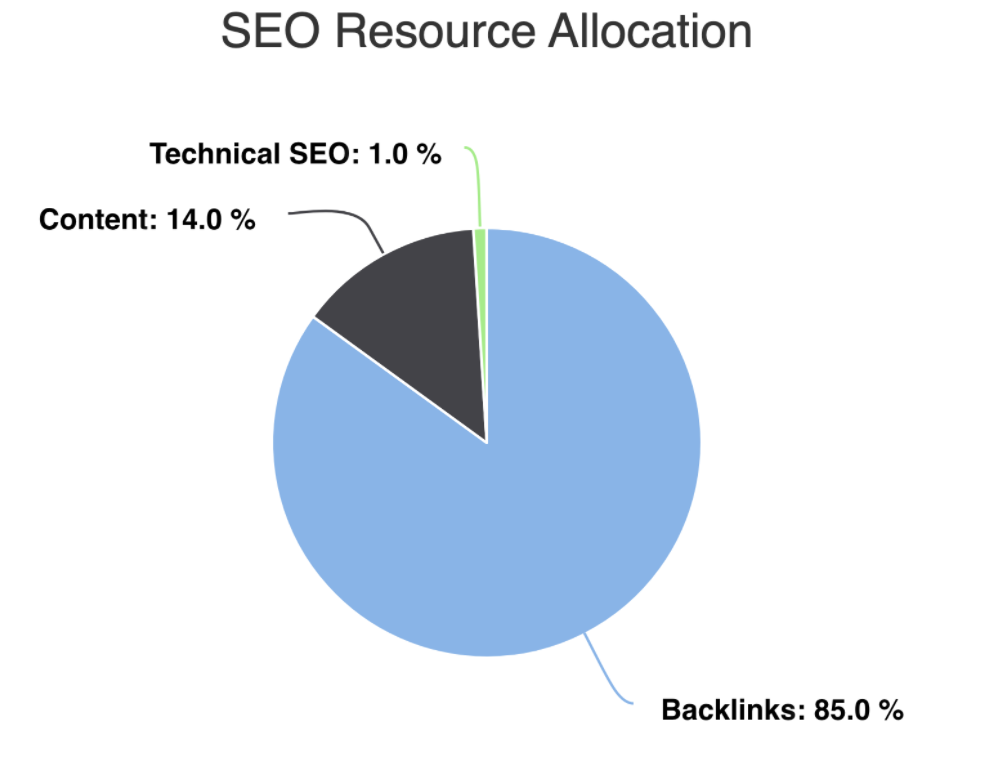
For this client, the brands at the top were winning on two things: dedicated, optimised pages for the most-searched keywords, and a lot of authority behind those pages. Authority comes from backlinks, mentions of your business on other websites. Technical SEO was a rounding error. So the plan was: fix what's broken once, optimise the pages, then pour 85% of the budget into authority.
That split is not universal. Some niches need no backlinks at all. That's precisely why the analysis comes first.
Fig. 05 · Resource allocation for this niche. Backlinks 85%, content 14%, technical 1%.
03
Execution, in order
What we actually did.
3.1
Technical fixes first, then quarterly checks
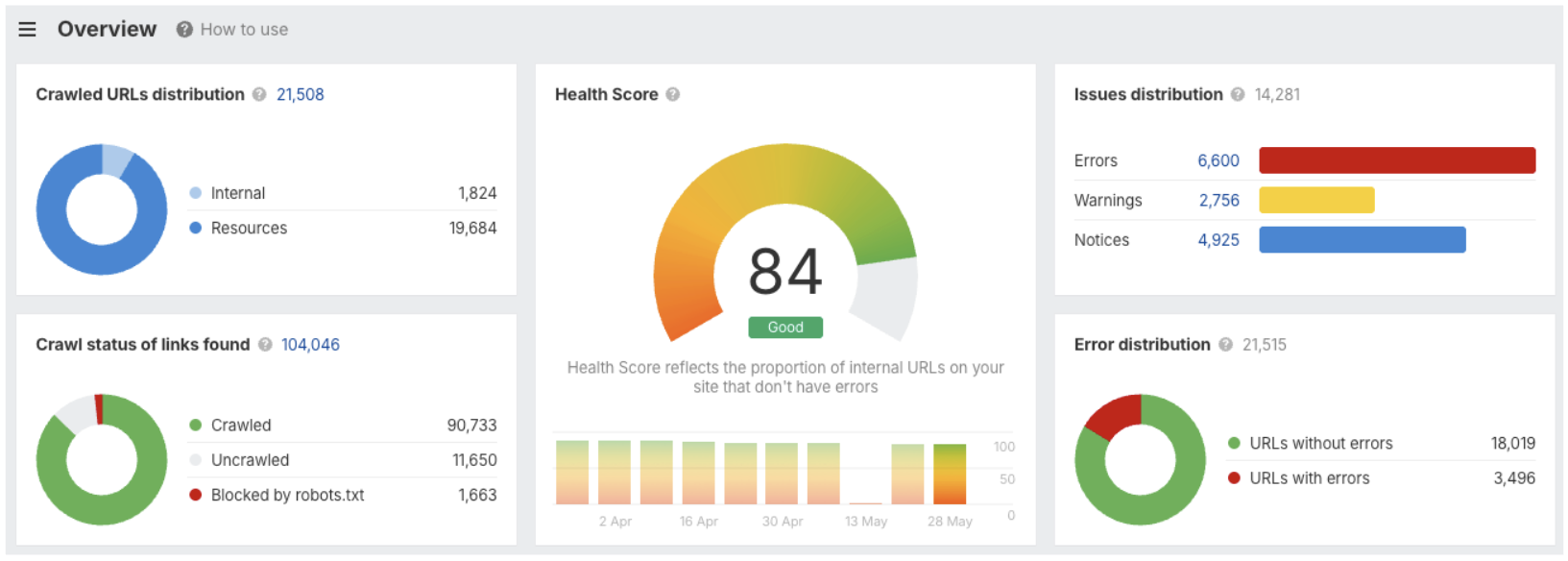
Only 1% of the budget, but we cover this base first. Technical issues rarely drive rankings, but they can hold them back from their full potential. We fixed the errors, then set a monthly check and a deeper quarterly audit. It's maintenance. It's boring. It has to be done.
Fig. 06 · A typical technical standing report. Health score, error and warning distribution across 21.5K crawled URLs.
3.2
Optimise the most important collection pages
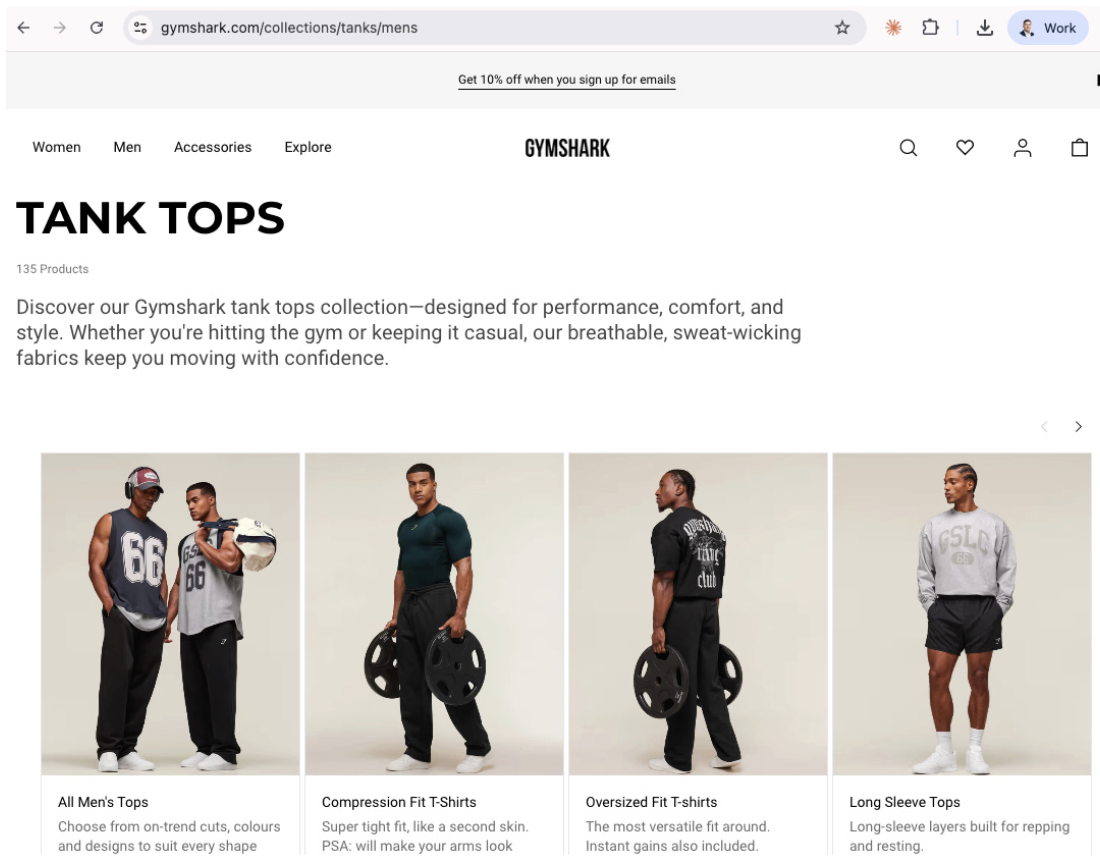
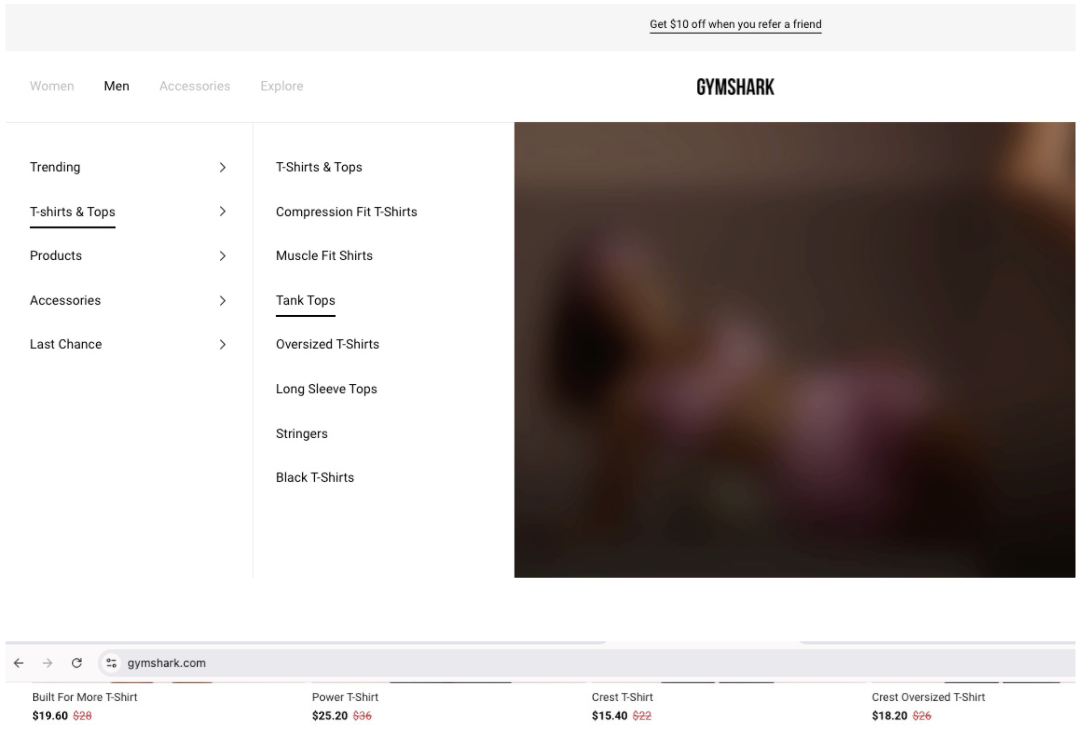
This is the biggest single win for most ecommerce stores. Figure out which collection pages match your highest-value keywords, then optimise them properly: title, URL, on-page copy, internal links. Gymshark's men's tank tops page is a clean example of what a collection page built to rank looks like. If you have a handful of collections, do them all. If you have hundreds, start with the ones tied to your best sellers.
Fig. 07 · Collection page built to rank. Keyword in the URL, H1, and intro copy; 135 products beneath.
3.3
Create new collection pages for quick wins
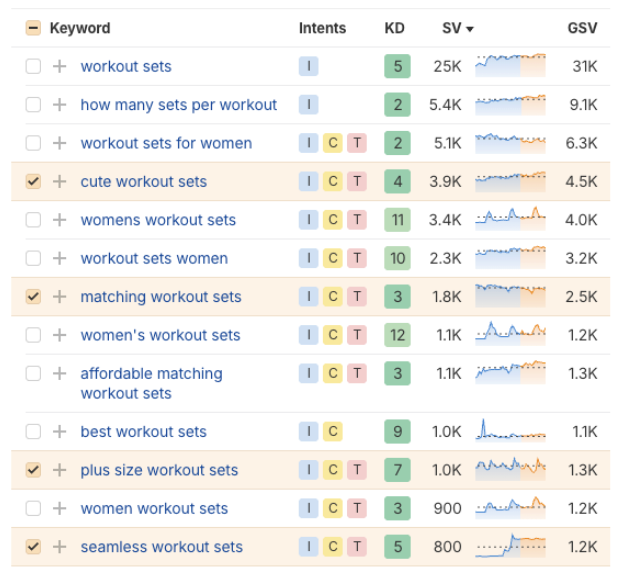
SEO takes time, and clients leave if they see nothing for months. So we go after fast money early to prove the channel works. The method: look at what the store already ranks for but has no dedicated page for. Gymshark has a "workout sets" page. People also search "cute workout sets" 3.9K times a month in the US, with a ranking difficulty of 4 out of 100. A dedicated collection with that title and URL is an easy win most competitors won't bother with. Same for "matching", "plus size", and "seamless" workout sets.
Fig. 08 · Quick-win candidates highlighted. Low difficulty, real demand, no dedicated page yet.
Pick all the low-hanging fruit, then reinvest what it earns into the harder, higher-volume keywords. That's how the compounding starts.
3.4
Fix the site structure
Simple, not easy. Your most important collection pages belong in the main navigation and on the homepage, because the homepage is almost always your strongest page. Gymshark puts tank tops one click from the top menu and promotes seasonal collections directly from the homepage. Do the same for the categories you most want to rank.
Fig. 09 · Priority collections in the primary navigation, one click from any page.
3.5
Build authority to collection pages, not the homepage
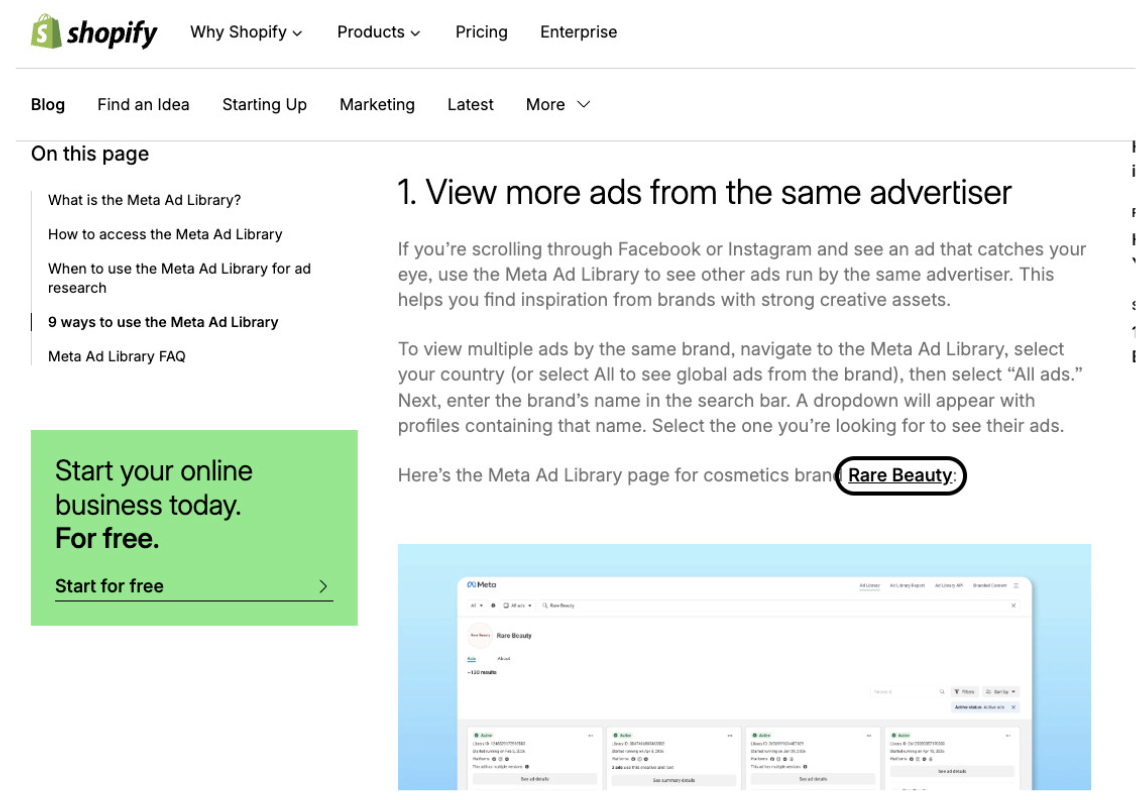
This is where 85% of the work went and still goes. If you're competing with Amazon and only build links to your homepage, you'd need tens of millions of dollars to match their authority. But you don't have to beat Amazon's domain. You only have to beat them on one specific collection page. So we build high-quality backlinks directly to the category pages that matter. Here's what a good one looks like: Shopify's own blog referring to Rare Beauty.
Fig. 10 · A high-quality editorial backlink. Relevant site, real context, in-content link.
3.6
Solve the seasonality problem with keyword research
Their core products are seasonal. We ran keyword research to find products with strong search demand and weak competition in the off-season, recommended them, and ranked the new collection pages. It worked, and it smoothed out their revenue curve.
04
Investment vs. return
$169,800 in. Over $8 million out.
They started at roughly $1,000 a month in 2021, moved to $3,000 (9K a quarter), and have been at $3,500 (10.5K a quarter) for about two years. Total to date: $169,800 over almost five years. Nobody keeps paying for five years unless it made sense early, and it did.
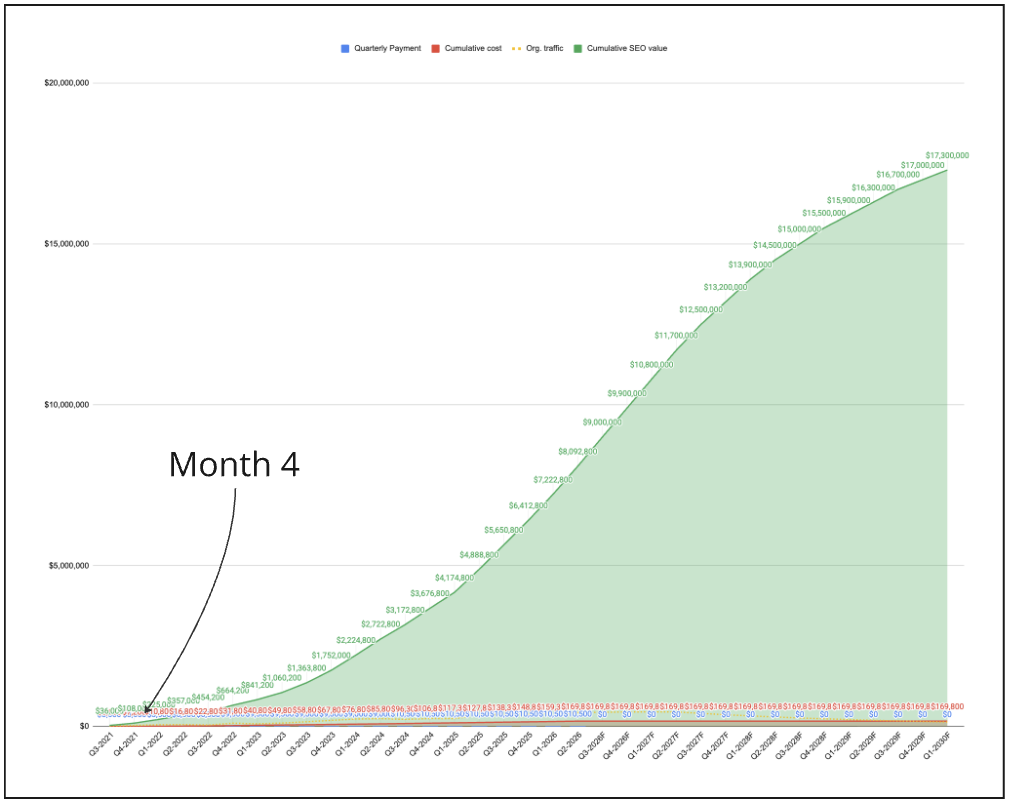
Revenue from organic traffic over the same period: over $8 million cumulative, measured in Google Analytics connected to their Shopify store. The $3.47M figure is the last 12 months alone.
And that undercounts it. A lot of people discover a brand through search, then come back through retargeting or type the name in directly. That revenue gets attributed to paid and branded channels, but SEO opened the door.
Fig. 11 · Quarterly payments (blue) and cumulative cost (red), Q3 2021 to Q2 2026: $169,800 total.
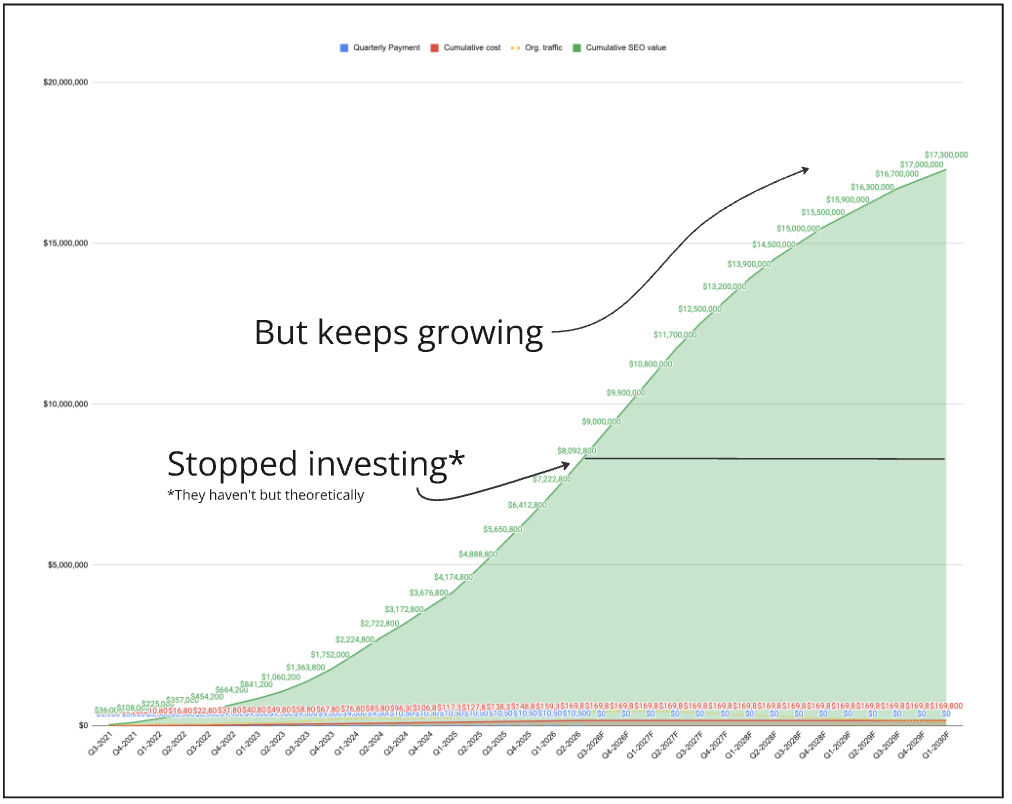
Fig. 12 · Cumulative value generated from organic revenue (green) vs. cumulative cost (red, barely visible). The arrow marks month 4: where most stores quit.
Non-branded organic revenue, 12 mo × 50% margin
~$1.5M profit
Company value added at 5x
$7.3M
Total value created (gross profit + EV)
$11M+
SEO was the first channel they got working profitably. The cash it produced funded influencers, paid ads, and everything else they scaled afterwards. This is how ecommerce stores get to the point of selling for $5M, $10M, $30M: multiple channels, all with a real ROI, and one of them compounding.
05
The part paid ads can't do
What if they stopped investing today?
Stop paid ads and traffic drops to zero the same day. SEO's big downside is that it's slow: five to six months for new stores, less for established ones. The upside is what happens when you stop.
Based on what we've seen across clients, a store that stops investing keeps growing for about six months on the back of work already done, plateaus for the next six, then declines at 3% to 5% a quarter. To be very conservative, I've modelled a 10% quarterly decline in the chart. Even then, cumulative value keeps climbing for years after the last invoice. The exponential curve flattens; the ROI keeps compounding.
That's why the brands that benefit from SEO are the ones willing to stick with it through the slow start.
Fig. 13 · Theoretical stop in investment (they haven't). Value keeps growing on a flattened curve.
06
Lessons learned
Four things that made the difference.
01
Diagnose the one gap that matters. Don’t do everything.
If Amazon is your competitor and someone tells you to do everything Amazon did, that’s 30 years and $30 billion. Find the biggest gaps and the lowest-hanging fruit, then compound from there. Here the order was technical, then pages, then links.
02
Collection pages plus links to them is where the money hides.
Optimising category pages for high-volume keywords and building authority directly to those pages drove the bulk of the revenue. This is the case for most ecommerce stores, not just this one.
03
SEO compounds massively, but only for brands that don’t quit at month four.
Most stores pull the plug at month four or five because nothing has moved yet. If you want an exit in 3 to 5 years, that is exactly when you should be starting, not stopping.
04
You can beat much bigger competitors with strategy and focus.
This client outranked Amazon and household-name US brands. Not by outspending them, but by picking the right pages and the right order. It started with the niche potential analysis.
Where the money hides: a furniture example
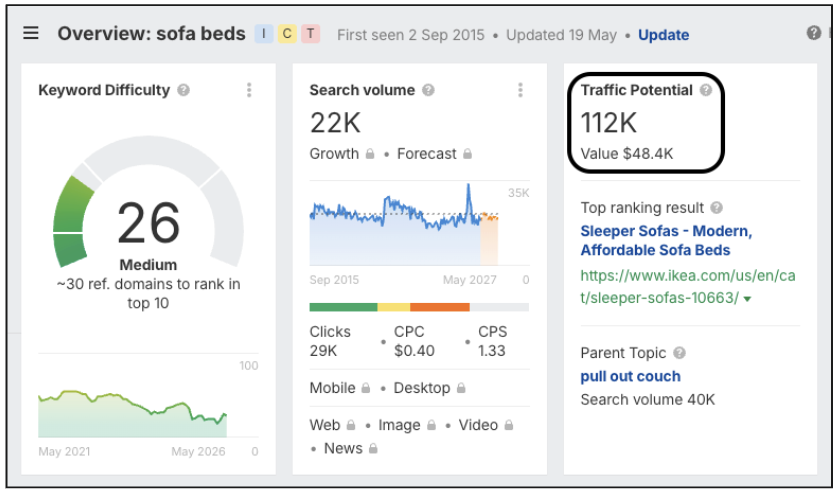
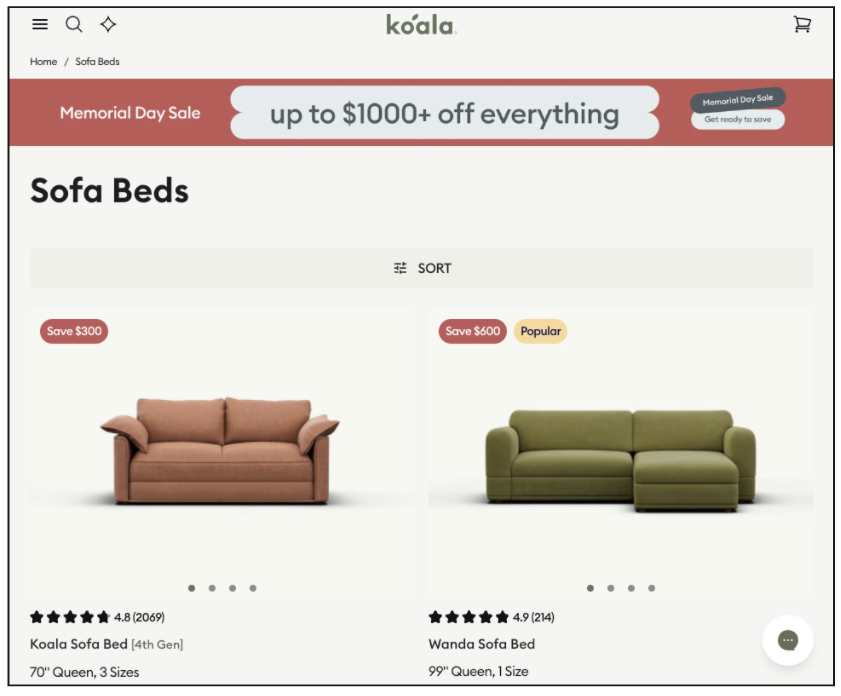
If you sell sofa beds, you need a sofa beds collection page, and you need to know the exact keyword to build it around. "Sofa beds" has 22K US searches a month and a traffic potential of 112K if you own the topic. Koala has the right page and the right keyword, but the page itself isn't optimised. That's the gap, and it's the same gap we found for this client in their niche.
Fig. 15 · Right page, right keyword, not yet optimised.
Free · 20 / month
It all started with step one
Find out if SEO is worth doing in your niche.
A personalised 5 to 7 minute video for Shopify, WooCommerce and BigCommerce stores doing $250K to $10M a year: is SEO and AI search worth pursuing in your niche, the revenue potential, the company value upside, and who's winning right now. Delivered in one to two working days. No follow-up calls, no chasing.